
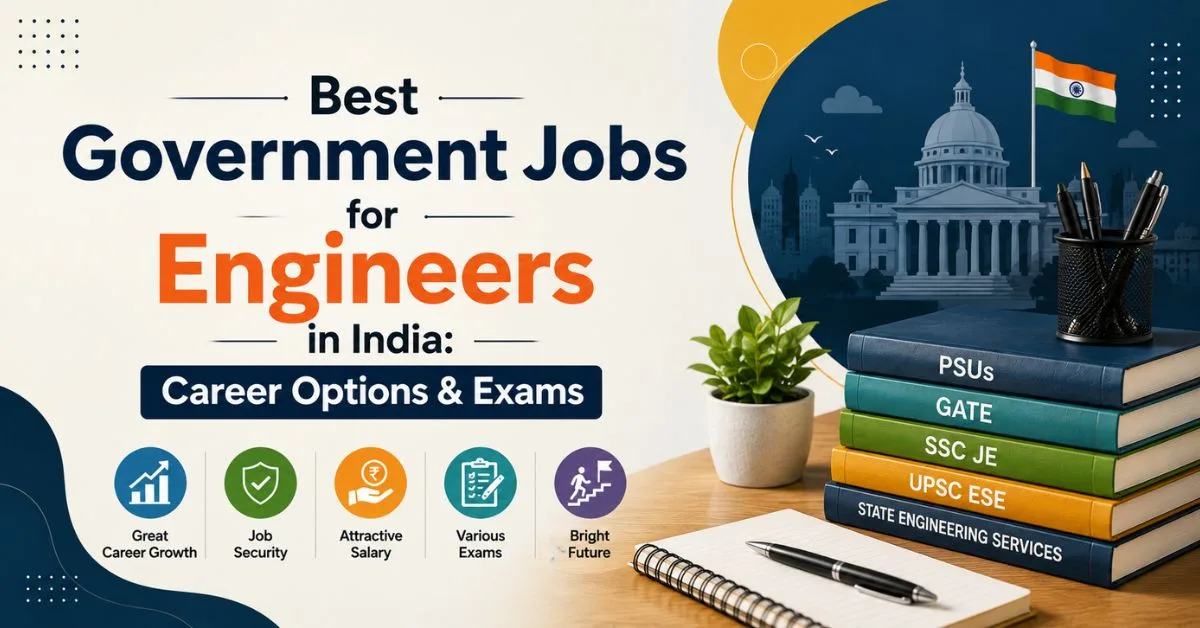

This dilemma seems to haunt each and every student of engineering in their life: go for a private placement or prepare for a government examination that may very well not accept one’s branch at all. While the point in question here is not the existence of government opportunities for engineers, they certainly exist, but rather which exam to prepare for, given the individual’s branch.
Government Job Options for Engineers
Route | Recruits through | Most suitable for | Starting salary |
PSUs like BHEL, NTPC, ONGC, IOCL, SAIL | Through GATE score, generally | Core branches | Rs 8-15 LPA |
Some PSUs conducting their own examination (BEL, HAL formerly) | Conducted separate written CBT test | Electronics, Mech, CS, EE | Rs 7-12 LPA |
Some Chemical/Petroleum PSUs (ONGC, Oil India, GAIL, HPCL, BPCL) | Through GATE score | Chemical, Petroleum branches | Rs 8-14 LPA |
Some Mining/Metallurgy PSUs (Coal India, SAIL, NALCO) | Through GATE score | Mining, Metallurgy branches | Rs 8-13 LPA |
Engineering services exam under UPSC (ESE) | Conducted its 3-tiered examination | Civil, Mech, EE, ECE only | Rs 80,000-90,000/month |
SSC Junior Engineer (JE) | Through SSC JE exam | Civil, Mech, EE branches | Pay Level 6 |
Junior Engineer/Senior Section Engineer (SSE) in RRB | Railway Recruitment Board | Civil, Mech, EE, ECE branches | Pay Level 6 |
AE recruitment board in states (TSPSC, APPSC AE, etc.) | State level examination | Branch-specific and state domicile | Variable, depending on state |
Scientist/Engineer in ISRO | Conducted through ICRB exam and Interview | ECE, Mech, CSE branches | Rs 7.5-9.3 LPA |
Scientist B in DRDO and CEPTAM | Through GATE score or DRDO conducted exam | CS, ECE, Mech, Aero branches | Rs 7-10 LPA |
OCES/DGFS of BARC | Conducted by BARC | Mech, EE, ECE, CS, Biomedical branches | Level 10, equivalent to IES |
Defence Forces (technical branches) | CDS, AFCAT and TES | Mech, EE, Aero mainly | Officer pay + allowances |
GATE
GATE, for most engineers, remains the most important exam that they must crack to succeed. This is because a good performance in GATE is what will give you an advantage to be considered for positions in PSUs such as BHEL, NTPC, ONGC and IOCL without taking any further written test and directly going for an interview. GATE also helps in securing admission in M.Tech courses in IITs and NITs, as well as in CEPTAM route for DRDO. The catch here lies in the fact that while your GATE scorecard is valid for 3 years for postgraduate admissions, in most cases, individual PSUs accept only the latest year's score for their recruitment process. Therefore, a score that will be enough for a current year's PSU notification may not even help in securing a position through a new PSU notification which may come after a couple of years, although it may be enough for securing admission in a current year's IIT M.Tech course. GATE is conducted in almost 30 subject papers ranging from Engineering Sciences and Data Science too.
PSUs do Not Recruit in the Same Manner
It is essential to highlight that PSU recruitment does not follow a uniform pattern of "GATE score and interview." For instance, BEL holds an independent written examination (CBT consisting of two parts, including technical aptitude, with negative marking applied). In turn, HAL has shifted from the GATE-based shortlisting process to holding an independent written examination and vice versa. Thus, it would be wrong to assume that both organizations recruit in the same way as ONGC or NTPC do. Moreover, a large number of PSUs hold a Graduate Apprentice Trainee program as a pipeline through which GATE qualified applicants get enrolled as apprentices for a year before their selection. In addition, the position offered by a PSU can either be in the executive cadre or in the non-executive cadre, whereas the former implies faster advancement and structuring of one's path to managerial positions and the latter – slower progress following a different scale.
UPSC ESE
While ESE selects Class-1 officers for recruitment in departments such as Railways, CPWD, Defence and power ministries, ESE considers only those candidates holding Civil, Mechanical, Electrical, and Electronics & Telecommunication degrees. This leaves the CSE and IT aspirants fooled, as they feel that ESE selects from all branches, which is not true. ESE comprises three rounds: Preliminary exam carrying 500 marks, objective type exam with negative marking, Main Exam carrying 600 marks, descriptive in nature without any negative marking, and finally the Personality Test carrying 200 marks.
SSC JE, RRB JE and State AE Boards
If a multi-year cycle is not suitable for you, SSC JE and RRB JE recruit Civil, Mechanical and Electrical engineers in Pay Level 6 based on a two-tier test which is much easier than the syllabus of UPSC. Apart from the "State PSC" kind of syllabus, most states conduct their own special Assistant Engineer examination through organizations like TSPSC and APPSC separately from the regular civil service examinations of that state, with its own cycle of notifications, domicile restrictions and syllabus. As far as engineers of Telangana and Andhra Pradesh are concerned, keeping track of TSPSC AE and APPSC AE notifications would help better than "state government job".
Beyond Core Engineering: Chemical, Metallurgy, Mining and Biomedical
While core branches attract more limelight, there are specialized PSU routes for Chemical, Petroleum, Metallurgy, Mining and Biomedical engineers as well. Recruitment of Petroleum Engineers is done in large numbers by ONGC and Oil India, for Chemical engineers by GAIL, HPCL and BPCL, for Metallurgy engineers by SAIL and NALCO, and Coal India especially for Mining engineers, all mainly through GATE. Biomedical and Biotech graduates can also follow a route to some extent via ICMR organizations, DBT organizations and biomedical engineering jobs in government hospitals, which are hardly ever mentioned in any articles on "engineering government jobs".
Research and Defence: ISRO, DRDO, BARC and the Armed Forces
There is huge competition for entry level posts in ISRO Scientist/Engineer-SC test and DRDO Scientist B test, which provide the opportunity to work on satellite systems and defense research and development not available in any private Indian company to that extent. The BARC OCES/DGFS test should be separately mentioned as Scientific Officers are given post of Level 10, equal to an IES officer, through their annual test but gets much less publicity compared to ISRO and DRDO, and the rare research path available to Biomedical engineers. In defense services, CDS and AFCAT take up engineers as technical officers mostly from Mechanical, Electrical and Aerospace engineering branches.
CSE and IT Graduates
The CBI is known to conduct recruitment for positions in cyber and forensics, whereas NIC and CDAC conduct their own drives for recruitment in technical domains. Further, IBPS SO’s IT cadre offers placements for candidates in Computer Science & Engineering and Electronics in nationalised banks with guaranteed promotion scope. UGC-NET along with GATE qualifies one for the position of Assistant Professor in government engineering colleges as well.
Reality Check
GATE numbers themselves are always in the low single digits, and PSU shortlisting brings that down even more as each PSU recruits just a few hundred engineers out of lakhs of GATE qualified candidates. The same is true for ESE as well, with thousands of Civil, Mechanical, Electrical and ECE candidates applying for a couple of hundreds of seats across the four streams. In fact, many engineers who finally get into a government job do not pass the exam of their choice on the very first attempt and end up joining SSC JE, RRB JE or even state AE jobs after failing in PSU and ESE respectively, which is a totally fine result, not a demotion. The problem with those candidates is not that they did not make it in GATE and ESE but that they never even bothered to attempt them to begin with, simply because they were not aware of the existence of this exam for their stream. It is also important to state the trade-off openly: government jobs and PSU jobs are stable and have slower but steady growth compared to fast-growing salaries but exposure to new technologies in private product companies. Neither is objectively correct; it depends on what you're optimising for at 22.
Selection Process and Preparation
The pattern of most of these routes has almost similar pattern: Written examination (GATE, ESE, or even PSU's own CBT), followed by document verification, and then interview/medical. For PSU recruitment through GATE, the written examination can be directly skipped and moved to interview. However, PSUs such as BEL would introduce their own written examination pattern. ESE has the toughest pattern which lasts about a year with three phases. The preparation time for GATE, ESE, ISRO or DRDO requires around six to nine months of focused study. For about two months, you need to brush up your basics, while next three months you should practice subject-wise problem solving and rest all is mocks and revisions. Preparation time for SSC JE, RRB JE or State AE is three to six months on aptitude and core subjects.
Pro-Tip: Never wait till the final semester to choose the exam route you have to prepare for, and do not think all PSU and states' examinations follow the same pattern. Make sure whether your PSU follows GATE or their own written examination, get valid GATE score for your chosen recruitment cycle, and choose some backup like SSC JE, RRB JE or State AE examinations in advance.
At Career Mitra, we provide you with updates on notifications, cutoffs, syllabus change for each and every exam conducted by GATE, ESE, ISRO, DRDO, BARC, State AE boards and PSU recruitment drives in real time basis, so bookmark our Government Exams section rather than visiting different websites again and again.
FAQs
1: Do all PSUs recruit only through GATE?
Not really. While some of the largest PSUs like BHEL, NTPC, ONGC etc recruit based on GATE scores, others such as BEL conduct their own separate written examination. And HAL has been alternating between GATE and independent recruitment in different cycles.
2: How long is a GATE score valid for PSU recruitment?
The scorecard is valid for 3 years for academic admissions but most PSUs consider only the current year's score for recruitment. Verify each PSU's cut off year individually.
3: Are there any government job opportunities for Chemical Engineers, Mining Engineers or Biomedical Engineers?
Yes. There is GAIL, HPCL, BPCL, ONGC and Oil India for Chemical and Petroleum engineers, Coal India for Mining engineers, SAIL and NALCO for metallurgy, and BARC OCES/DGFS pathway along with ICMR affiliated and government hospitals biomedical jobs for Biomedical Engineers.
4: Can a CSE/IT graduate apply for UPSC ESE?
No. It is restricted to Civil, Mechanical, Electrical and E&T.
5: Is it true that an engineer ends up in SSC JE or a State AE after trying GATE or ESE?
Yes. In fact it is a very decent result and not a failure as many people think. Many engineers consider it as a very legitimate back-up while preparing for other better exams.
6: What is the actual trade-off between a Government Job and a private sector job for an Engineer?
Government/PSU jobs provide job stability, pension and steady long term growth. But private firms usually are quick in providing a good salary and exposure to the latest technologies.
For a personalised comparison of government exams that match your specific branch, explore more career resources on Career Mitra