
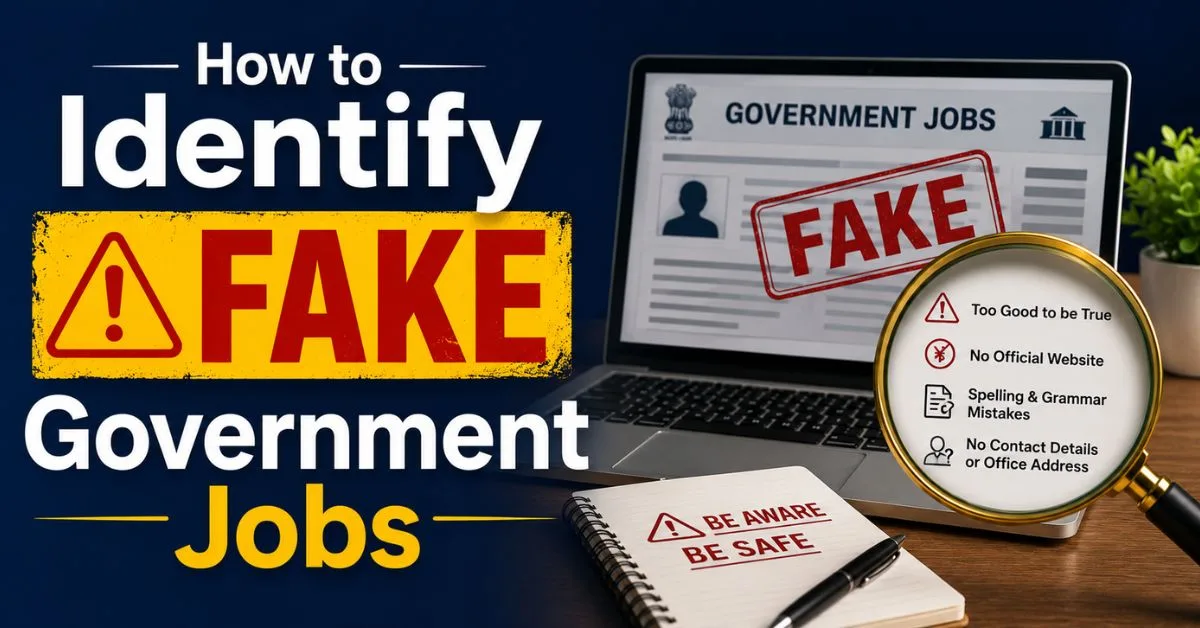

Government job notifications have become one of the easiest tools for scammers to exploit. Fraudsters now copy government logos, department names, recruitment formats, and even admit cards closely enough to make fake notices look convincing.
The Press Information Bureau's Fact Check Unit had published 2,913 fact checks by April 2026, addressing false claims about the central government. The list includes fake notifications, forged letters, and fraudulent websites. Recruitment fraud lies within that count.
In May 2025, the Cabinet Secretariat issued a public denial after a fabricated advertisement for 1,736 Field Assistant posts spread widely enough to generate fake admit cards for an exam that never existed.
These cases point to one conclusion. The safest way to evaluate a government job notification is not to judge whether it looks genuine. It is to establish whether the recruitment exists independently of the message, through the organization actually responsible for conducting it.
Why a Convincing Notice Is Not Enough
Fake recruitment notices circulate through WhatsApp forwards and Telegram channels. These formats let a recruitment claim spread fast, far beyond the organization that supposedly issued it. The wider spread of AI-generated and manipulated content has made visual appearance a weak test of authenticity on its own.
Two conditions make this harder for candidates to manage. Genuine vacancies are announced by a fragmented set of authorities: UPSC, SSC, Railway Recruitment Boards, the Cabinet Secretariat, and dozens of state public service commissions.
Most applicants have no single trusted source they check by habit. At the same time, the pressure of competing for stable government employment pushes people to apply before they verify anything.
How to Tell if a Government Job Notification Is Fake
Confirm three things before treating a notice as real. The vacancy should appear on the recruiting organization's own official website. The application portal should be linked directly to that organization's site.
The fee and process should match what the organization has published. A notice that cannot be traced to an independent, official source should not be acted on, no matter how polished it looks, until it is confirmed.
The Five-Point Verification Chain
A single red flag rarely proves fraud on its own, and a single missing red flag does not prove a notice is genuine. Verification works better as a chain. Each link should independently confirm the last.
1. Verify the recruiting organization: Identify exactly which department, board, or commission the notice claims to represent. Confirm that this body actually conducts recruitment for the post described. Some fraudulent notices name real organizations for posts. Those organizations have no role in filling the post.
2. Verify the original notification: The advertisement should be traceable through the recruiting organization's official recruitment pages, typically under its own advertisement or reference number and publication date. If it is not there, that absence is a stronger signal than any visual inspection of the document itself.
A related habit worth building is not to treat a search result as an official source. A website appearing near the top of a search for a department's recruitment page is not proof, on its own, that it belongs to the government. Open the organization's known official website directly, from a bookmark or a source already trusted, and follow its own recruitment links from there.
3. Verify the application channel: Confirm that the application portal is the one the recruiting organization itself links to, not a separate site that merely resembles it. A notice can be genuine in its wording and still route candidates to a fraudulent third-party portal.
4. Verify the payment process: Genuine government exams do charge legitimate application fees, so a fee request alone is not a warning sign. What matters is whether the amount and payment method match what the organization has published through its own gateway, rather than a personal UPI ID, bank account, or informal transfer.
A request to send money to a personal account is a major fraud indicator and should not be treated as an authorized process without independent confirmation.
5. Verify the contact details independently: Call the helpline number published on the organization's own website, not the number printed only inside the notice. This closes the loop scammers rely on when they print a fake helpline staffed by their own associates.
This last point applies to every step above. Never use a phone number, email address, or website supplied only by the notice itself to verify that same notice. A scammer who controls the claim should not also control the evidence used to check it.
The Stop Rule
If the recruitment cannot be independently traced to the organization responsible for conducting it, through all five points above, the correct response is simple. Do not pay, submit documents, or move to the next stage until the discrepancy is resolved.
Signals That Should Trigger Verification, Not Conclusions
Certain features of a notice are worth treating as prompts to run the chain above, not as proof by themselves.
Lookalike domain: the URL resembles the organization's name but adds extra words, punctuation, or an unrelated domain, for example, a lookalike address standing in for the organization's actual .gov.in site.
Urgency: pressure to apply or pay within a day or two, leaving no time to check.
Unofficial payment: money requested through a personal UPI ID or bank account instead of the organization's own gateway.
Unverified contact: the only phone number or email appearing anywhere is inside the notice itself.
Document inconsistencies: reference numbers, dates, formatting, or organizational details that do not line up.
None of these confirms fraud on its own, and a polished document with a correct-looking domain does not confirm legitimacy either. A government logo can be copied. A recruitment trail traced back through the five-point chain is far harder to fake.
How Fake Recruitment Scams Continue After the Notice
Some scams are built to keep working past the point where a candidate believes they are dealing with a real process. The Field Assistant case illustrates this well. The fraudulent recruitment advertisement was accompanied by fake admit cards for an examination that did not exist, and the fraud stopped only once the Cabinet Secretariat issued a public denial through PIB. A similar lifecycle appears in many recruitment scams, moving across four stages.
Stage 1: The fake application: A fabricated advertisement draws candidates to a portal that is not linked from any official recruiting site. A fee is collected through a personal UPI ID or account instead of the organization's own gateway.
Stage 2: The fake admit card: An admit card arrives for an exam scheduled at a private venue rather than an authorized center. It often carries a further verification fee due on the exam day itself.
Stage 3: The fake interview or selection call: A phone call informs the candidate that they have cleared an earlier stage and now owe a security deposit or processing charge to proceed. This demand should be checked against the organization's own published recruitment information before any payment is made, regardless of who the caller claims to be.
Stage 4: The fake appointment or joining communication: A selection or joining letter arrives requesting further processing or verification payment before onboarding can proceed. A genuine appointment communication can be confirmed directly with the recruiting organization using its own published contact details. Any payment demand attached to it should be checked the same way.
The fraud at every stage above continues only as long as the candidate has not independently verified it. That is why the five-point chain from the notification stage is worth repeating each time a new document or call claims to represent progress.
What to Do After Responding to a Fake Notice
Preserve every piece of evidence connected to the notice: screenshots, payment receipts, phone numbers, and any WhatsApp or email correspondence. Call 1930 or report at cybercrime.gov.in as soon as possible to report financial cyber fraud and support rapid action.
The same portal also accepts reports of suspicious websites, phone numbers, WhatsApp numbers, and email IDs, even where no money has changed hands. This is worth using the moment a notice looks doubtful, not only after a loss. Separately, notify the department whose name was used.
A documented pattern of complaints helps it issue its own public warning sooner. For claims involving the central government specifically, PIB Fact Check at factcheck.pib.gov.in, or WhatsApp 8799711259, offers an additional verification route.
Quick Verification Table
What to Check | Stronger Evidence | Warning Sign |
Source | Listed on the recruiting organization's own website | Only circulating through social media or forwards |
Domain | Matches the organization's verified official site | Lookalike or unrelated domain |
Contact | Independently confirmed via the organization's own listing | Number or email printed only inside the notice |
Payment | The method and amount match the organization's published process | Personal UPI ID, bank account, or informal transfer |
Application | Linked directly from the official recruitment page | Separate third-party application link |
Verification | Confirmed through an independent official source | Cannot be traced back at all |
Final Thought
Fake recruitment notices will continue to become harder to spot. The safest technique is simple: verify every government job notification through the five-point verification chain before applying, paying, or submitting documents. Don’t wait for a notice to look suspicious. Verify first, then act.
FAQs
How can I verify a government job notification?
Verify the vacancy on the recruiting organization's official website first. Then independently match the advertisement number, application portal, fee process, and contact details against that same source.
How do I know if a government recruitment website is genuine?
Check whether the recruiting organization's own official site links to it. A domain that merely resembles a government address is not sufficient confirmation on its own.
Do all government jobs require an application fee?
Many legitimate government exams do charge a fee, so a fee request alone is not a warning sign. What matters is whether the amount and payment method match what the organization has published through its own gateway.
Where can a fake government job notification be reported in India?
Report it through the National Cyber Crime Reporting Portal at cybercrime.gov.in or the helpline at 1930. The portal also accepts reports of suspicious websites and numbers, even where no payment was made.
What should you do after paying a fake recruiter?
Report it immediately to 1930 or cybercrime.gov.in. Preserve all receipts and correspondence, and notify the department whose name was used so it can issue its own warning.