
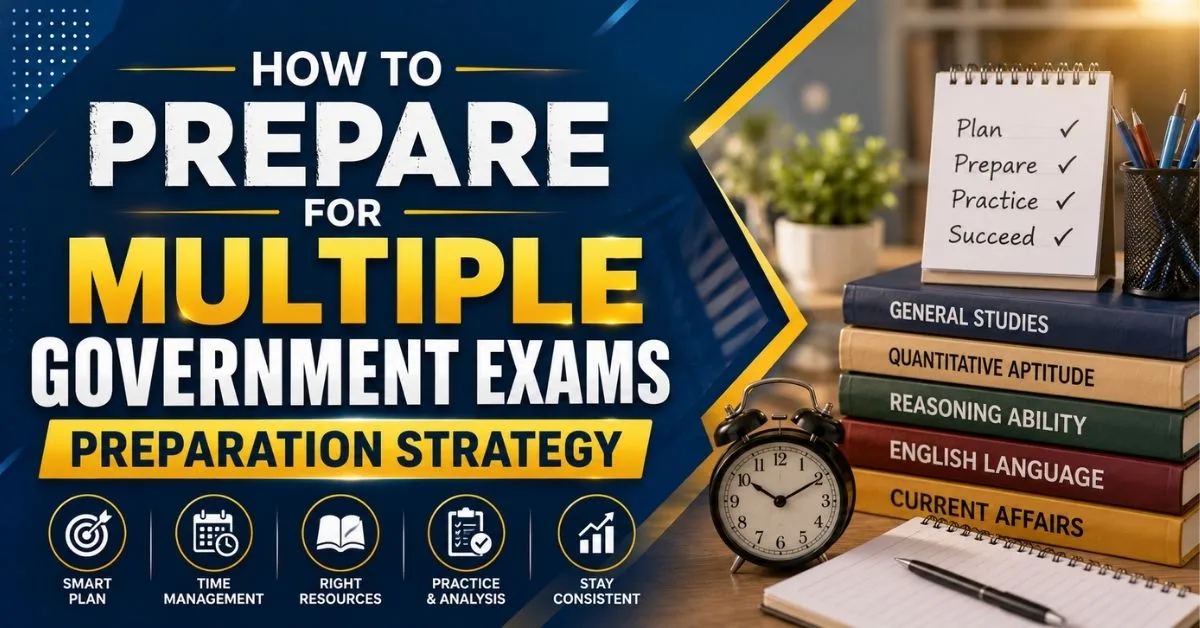

Every year lakhs of aspirants appear for more than one government exam in the same cycle. SSC CGL , A bank PO exam . Maybe an RRB notification thrown in for good measure . It's not that they can't make up their minds. Government recruitment is not waiting for anyone to be ready for only one thing at a time. Most candidates simply cannot afford to stake everything on a single notification.
The challenge is, studying for two or three exams at the same time, without a schedule, often backfires more than studying for one exam well. Aspirants have to manage several books, several test series, several syllabi and by exam time they’re tired and underprepared for all of them. This guide, presented by Career Mitra, explains how to do it properly: which exams go well together, how to split study time and how to create a schedule that doesn’t fall apart the moment mock scores fall.
Is It Possible to Prepare for Multiple Government Exams Together?
Yes and for a large section of aspirants it is closer to the norm than the exception. The topics in most government exams are largely the same: quantitative aptitude, reasoning, English or a regional language and general awareness. Especially, SSC and banking exams are almost based on the same foundation. Both exams test simplification, percentages, profit and loss, ratio and proportion, and data interpretation in quant; syllogism, coding-decoding, blood relations, and seating arrangement in reasoning; and reading comprehension, cloze tests, and error spotting in English.
But the reality of dual preparation is not simply about common subjects. It is the usual calendar. Most exams are conducted in multiple stages (prelims, mains and sometimes an interview) over many months. Many times, the prelims of one exam and the mains of another exam are at exactly the same time. Candidates who utilise that gap to prepare well for a second exam, rather than sitting idle waiting for a mains admit card, get more out of the same number of months.
The problem comes when the two tests are almost entirely unrelated. For example , the UPSC ’s civil services syllabus overlaps with SSC or banking , but mostly at the edges . English and general awareness have some common ground , but the analytical and essay writing demands of UPSC don't transfer the way SSC and banking transfer into each other . In the case of UPSC plus a speed-based exam like Bank PO, it's a lose-lose situation usually.
How Many Government Exams Should You Prepare for at Once?
Most successful multi-exam aspirants choose two. Three is possible only when the exams have huge syllabus overlap, such as SSC CGL, SSC CHSL and an RRB undergraduate-level post where the basic quant, reasoning and general awareness are almost the same. Beyond three, good preparation for any one exam is almost impossible, as revision time gets split into slivers too thin to really consolidate anything.
A simple test of overcommitment would be to create a list of your desired exams with the probable exam months for each of them. If you find more than two such exams that have overlapping months within a period of six weeks and whose syllabus does not share 60 to 70 percent similarity, then you should expect underperformance in one of them.
Pro-Tip: Select one "primary" exam and one or two "secondary" exams. Devote about 60 percent of your study hours to the primary exam, while the secondary exams should be considered as just an extension of the same subject.
How to Choose Government Exams That Can Be Prepared Together
Some combinations do not work. Selecting the right combination helps in saving time spent on futile efforts.
Compare the Syllabus and Exam Pattern
Always begin with the PDF notifications provided by the organization. Write down the topics that are tested, the weightage of each topic, and the structure of the exam including how many tiers there are in the test, negative marking, and the time allocated for each section. While SSC exams generally allocate more time to answer questions, banking exams have sectional timing for each question. The preparation approach differs greatly between both even though the topics tested may be the same in both exams.
Identify Common Subjects and Topics
Mark all those topics which are common in both the syllabuses. Topics like simplification, number series, percentage, average, time and work, and basic data analysis come in almost every SSC exam as well as banking exam; however, banks take this to the next level where the questions are more in number and require speed as well. Puzzles and seating arrangement also come in both, but the bank questions are more complex as compared to SSC ones.
Create a Common Study Plan
The foundation should be built before constructing the overall schedule. Don't divide quant prep into two different things like "SSC quant" and "bank quant"; the two are the same subject in different forms. One solid quant preparation session, accompanied by practice sets for each exam, can take care of both.
Separate Exam-Specific Topics
After the common area is identified, list the subjects unique to each examination. Advanced mathematics, algebra, geometry, and trigonometry are topics present in SSC CGL Tier II but not covered in the banking examinations. Financial acumen, computer aptitude, data sufficiency, and input-output logic are topics unique to the banking exams but not covered in SSC exams. The specific parts of the examination have separate slots as they are not double-barreled.
How to Divide Study Time Between Exams
The split that people have found practical is 60-40 in case one test is nearer to the date, and 50-50 if both the tests are of equal importance to them and are distant from the date. 60-40 split usually works fine, i.e., one should allot the extra time to the tier 1 of the test that is nearer in terms of dates, and then change the split after completing it.
One must not try to divide the day on an hourly basis among different tests. Instead, one should devote a whole two or three hours to a part of a particular test, while another long session may be left to the subjects common to the both tests. This way makes the sessions more focused than covering five subjects per session.
How to Create a Daily Study Schedule
The daily schedule for studying for multiple examinations will divide into four segments: one segment for the morning time, which will include the subject that requires maximum attention, probably quant or reasoning; another segment for midday time, covering common subjects from both examinations; a third segment in the evening for specific subjects of examination; and a fourth small segment, around 30-45 minutes, for revision.
An example of the six-hour schedule for weekdays would be:
6:00 AM - 8:00 AM: Quantitative Aptitude (covering both)
8:00 AM - 9:00 AM: Reasoning Ability (Basic + Complex Puzzles)
6:00 PM - 8:00 PM: Subject for exam (alternating from day to day - Exam A / Exam B)
8:00 PM - 9:00 PM: English Language & Vocabulary
9:15 PM - 10:00 PM: Current Affairs & Revision
Professional workers or students who have less free time could make this a three to four hour session without changing its four-step structure.
How to Create a Weekly Study Plan
When we take a look at the bigger picture for the entire week, the purpose of balancing the entire syllabus becomes the focus point rather than covering the same topics day after day. The structure for an efficient routine would be five weekdays dedicated to the coverage of new topics, divided between the general and exam-specific topics, one day solely dedicated to conducting complete mock tests, and one day for revision.
One should make sure that the exam-specific topics for either of the exams do not get skipped for two or three days in a row, otherwise, that is when the preparation for multiple exams starts to break down, because playing catch-up means losing revision time meant for something else.
Subject-wise Preparation Strategy
Quantitative Aptitude
The basics including arithmetic, percentage, profit/loss, time speed and distance, and data interpretation all come on one continuous line for both SSC and banking. However, topics like algebra, geometry, and trigonometry fall under the ambit of SSC CGL Tier II only, while permutation, combination, and probability can be found mostly in banking mains. Make sure you practice the basics as well as the distinctive part of each test, and just before the exam date, start practicing sets from the particular pattern.
Reasoning Ability
There is no doubt that reasoning cuts across all the government entrance examinations to a greater extent than any other section. Syllogisms, Coding-Decoding, Blood Relations, and Direction Sense remain very much the same in every SSC, banking, and state PSC entrance examinations. The difference comes with regard to difficulty level, where the banking entrance examinations take the form of puzzles and seating arrangement questions which are multi-variable and circular in nature, whereas the questions in SSC are relatively easier.
English Language
Grammar rules, one-word substitutions, and reading comprehension strategies remain constant in all exams. Vocabulary built by reading each day will come in handy, no matter what the next exam may be. Question style is where exams diverge, SSC favors more direct error-spotting and sentence improvement, while banking leans into cloze tests, para-jumbles, and inferential reading comprehension that demands faster processing. Descriptive writing, essays and letters, shows up specifically in SSC-CGL Tier III and in PO-level banking mains, and needs separate, dedicated practice rather than being folded into general English prep.
General Awareness and Current Affairs
This is where your preparation for multiple exams will really pay off in terms of time-saving. One daily activity of spending fifteen to twenty minutes with a trusted news source suffices for all the exams on your list because different exam conducting authorities use the same events. Static GK, history, polity, geography, and science have their own specific pattern for revising which can be done once a month by going through compiled notes rather than preparing it from scratch before every exam. In case of banking, add financial awareness and banking terminologies because they hold some value in PO and clerk level mains but not in SSC.
How to Manage Different Exam Patterns
Even when there is significant overlap in subject matters, pattern variations remain quite common. The SSC exam gives relatively more time per question than the other and favors structured problem solving rather than conceptual knowledge. Banking exams operate on sectional timings where speed and decision-making become as important as accuracy. For example, one exam may have negative marking of 0.25 mark per wrong answer while another may have negative marking of 0.33 and yet another may have no negative marking in some sections.
Carry only one-page reference per exam including the number of questions, total time allowed, negative marking criteria, and sectional cut-offs wherever applicable. Check it out before attempting every mock test for that particular exam so that your attempt pattern, section to attempt first, number of questions to be left etc., is according to that particular exam format and not the general pattern that suits none.
Mock Test Strategy for Multiple Exams
Practice mock tests in the actual format and time limit of each exam, not in any general combined test series. If a problem in quant takes ninety seconds in one exam format, then the same question may take fifty seconds to solve in the other in order to maintain your timing; hence, it is imperative to practice only pattern-specific mocks. The ideal way to do so would be to practice one mock per week per exam format starting three months prior to the exams, and two mocks per week for each exam during the last month prior to tier 1 of each exam. During other times, one combined test every ten days is sufficient.
Previous Year Question Papers
Try solving previous year papers of the exams separately rather than in a combined manner because actual papers have a different level of toughness compared to the mock test series. Previous year papers will tell you about the repeated topics of each examination body that a general mock cannot provide. Try at least five years’ worth of papers of each exam before the respective Tier 1.
Revision Strategy
Have individual error logs for each test with a common error log for general topics. In case there is any error found in the practice test related to Quant or Reasoning, it should be added to the common error log because solving it once helps you in both tests. If the error is related to a particular exam’s specific topic or pattern such as advanced maths, financial knowledge, banking puzzle, etc., it should be added to the particular test’s error log.
How to Prioritize Exams When Exam Dates Are Close
In cases where the two examinations occur during the same two or three weeks, the candidates will have no choice but to decide which examination is more important for them to pass – be it the exam with better positions or the more open positions or the exam that they find themselves well-prepared for.
Tip: during the two last weeks preceding either examination, the candidate should discontinue learning new material concerning the exam that is farther away and focus solely on revision for the nearer exam. Once the nearer exam has been completed, all the energy should be concentrated on the second exam, regardless of whether the process will be intense and short-lived or not.
Common Mistakes to Avoid While Preparing for Multiple Exams
Aspirants giving many examinations at a time face common mistakes. The first is buying books or attending a course for each individual exam instead of a general foundation book which will cover the content of both the exams. Constantly switching subjects in a study session rather than studying for a specific topic for an hour leaves you with no knowledge retained. Ignoring some exam-specific topics till last month under the thought that "it'll all come together" often becomes counter-productive because the topics require their own space to learn, like advanced maths for SSC CGL or financial awareness for banking mains.
Not using a good performance in mocks for one exam's paper style as a gauge for your readiness in another exam's paper style is a huge mistake because even if your SSC Quant is good, it doesn't mean you are prepared for Banking where sectional timing and difficult DI are required. Burn out is also common because of constant dual-preparation for many months which exhausts people mentally and not sleeping and taking breaks in order to increase the study hours becomes counterproductive as far as retention is concerned. And lastly, not revising and trying to study continuously also causes problems as the load in two syllabuses is huge and revision feels optional.
FAQs on Preparing for Multiple Government Exams
Can two government exams be prepared simultaneously by a beginner?
Yes, only if there is a considerable amount of syllabus common between the two examinations, like SSC CGL and SSC CHSL, or both SSC and Banking. A beginner is advised not to combine two very diverse exams like UPSC and speed based banking until his foundation is properly built.
How much daily study time is required to prepare for multi-exams?
Daily six to eight hours are sufficient for full-time aspirants. Working professional aspirants can do with three to four hours of effective study daily. Most aspirants attempting to prepare for SSC and Banking will take anything from six to twelve months of their time to get all the common things and also the individual parts of their exam.
Do I need to join separate coaching/test series for each exam?
No. One good resource for common subjects, Quant, Reasoning, and English, along with individual exam material where the syllabi differ is a better approach than joining separate coaching programs for both the exams.
If I start lagging in one of the exams?
Then immediately re-look into your time division strategy rather than postponing this task. Devote more time to the exam which you lag in for one-two weeks and after making it fine, again divide your time between these two examinations.
Should I attempt fewer exams and prepare more thoroughly?
Yes, it is recommended for most of the aspirants. Two thorough preparations always beat three to four unprepared attempts. It is better to fill less number of forms than many but thoroughly prepare for those.