
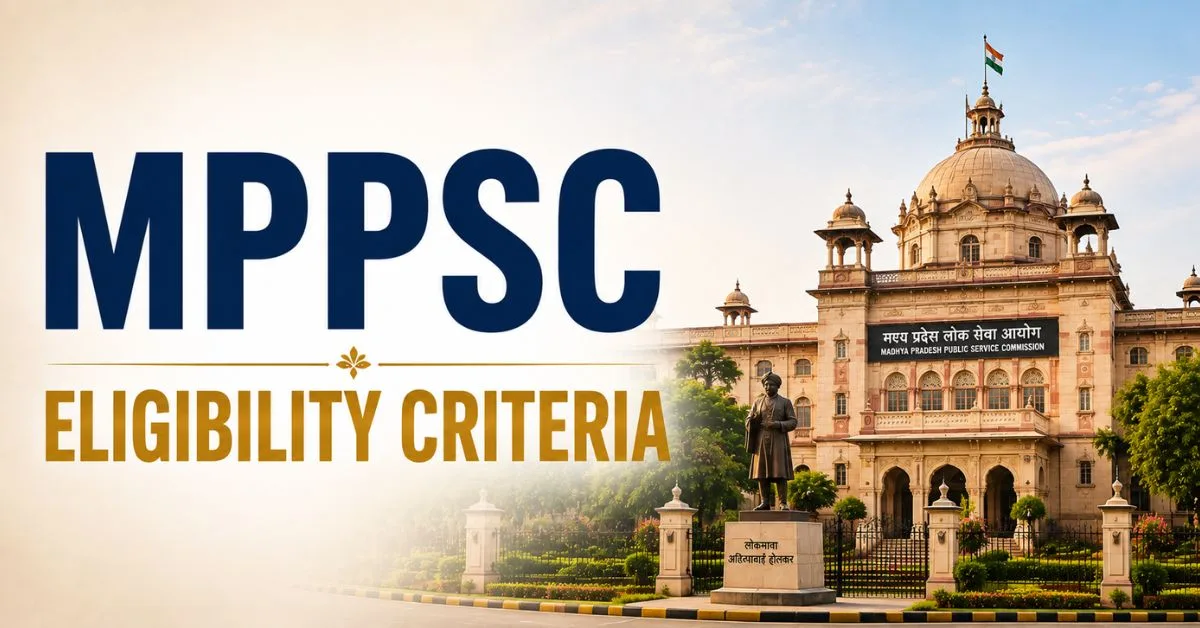

The Madhya Pradesh Public Service Commission runs several parallel recruitment cycles through the year rather than a single unified exam. In 2026, the commission issued notifications for the State Service Examination, the State Forest Service Examination, Assistant Professor recruitment across multiple subjects, and the State Eligibility Test.
Candidates tracking MPPSC updates should treat these as separate pipelines, each with distinct vacancy counts, qualification requirements, and exam calendars.
For the first time in its history, the Madhya Pradesh Public Service Commission has added negative marking to its state service prelims. That single change has reshaped how thousands of candidates are approaching the 2026 exam cycle, shifting the focus from attempting every question to answering with precision. It is a strong signal that MPPSC is aligning its selection process more closely with national-level exams like UPSC, where accuracy has always mattered more than speed.
The commission released Advertisement No. 29/2025 on December 31, 2025, opening 155 vacancies across administrative and police services, including Deputy Collector and Deputy Superintendent of Police posts.
Applications opened on January 10, 2026, and closed on February 9, 2026, with a late correction window that stayed open into spring for candidates who needed to fix errors in their forms. The Preliminary exam took place on April 26, 2026, marking the start of a selection process that will run through the Mains and Interview stages later in the year.
Eligibility for this exam rests on a mix of factors: nationality, education, age, domicile, and, for certain posts, physical fitness. None of these operates in isolation. A candidate can meet the general qualification bar and still miss out on a specific post if the finer conditions attached to that role are not met. That is the part most aspirants overlook, and it is worth breaking down properly.
Who Can Apply and Where Domicile Fits In
Indian citizenship is the only nationality requirement to sit for the exam. A Madhya Pradesh domicile is not needed simply to apply. Candidates from other states can register and compete for the same posts as local candidates.
Where domicile matters is reservation. Candidates without Madhya Pradesh domicile are placed in the unreserved category, regardless of what category certificate they may hold from their home state.
A candidate holding an OBC certificate issued in another state, for instance, cannot use it to claim OBC reservation in Madhya Pradesh. This distinction trips up a fair number of applicants every year, mostly candidates from neighbouring states who assume their existing category status carries over.
Nationality, domicile, and category are three separate boxes on the application form, and each has its own set of rules. Getting one right does not automatically satisfy the other two.
Educational Qualification Requirements
A bachelor's degree from a recognized university is the baseline requirement for the state service posts. The subject of the degree rarely matters for the mainstream administrative roles, so candidates with degrees in commerce, science, arts, or engineering are all eligible on equal footing.
Final-year students can apply provisionally, provided they complete their degree before the Main exam and can produce proof of the same when asked. Degrees earned from institutions outside India need recognition from the Government of India before they count toward eligibility. Specialized posts such as those in the forest, medical, teaching, or engineering departments often carry additional qualification requirements specific to that field.
Reading the exact advertisement for the post in question is the only reliable way to confirm eligibility for these roles, since the general bachelor's degree rule does not always apply.
Age Limit and Relaxation Rules
Age eligibility is calculated as of January 1, 2026, and it varies depending on whether the post is uniformed or non-uniformed.
Post Type | Minimum Age | Maximum Age |
Non-uniformed posts | 21 years | 40 years |
Uniformed posts | 21 years | 33 years |
Relaxation on the upper limit is available under Madhya Pradesh government rules, mainly for original residents falling under SC, ST, OBC, women, and a few other specified categories. The exact number of years varies by category and post, and candidates are generally allowed to claim only one relaxation even if they technically qualify under more than one head.
Checking the precise figure in the official notification is safer than relying on a general estimate, since this detail changes across cycles and sometimes across posts within the same cycle.
A relaxation granted for one post or category should not be assumed to apply elsewhere. Documents submitted at the verification stage need to match the date of birth and category details declared in the application, without exception.
Physical Standards for Uniformed Posts
Physical fitness requirements apply only to specific uniformed roles, mainly those tied to policing, excise, jail, and transport departments. Administrative posts carry no such condition.
Candidate | Minimum Height | Chest, Unexpanded | Chest, Expanded |
Male | 168 cm | 84 cm | 89 cm |
Female | 155 cm | Not applicable | Not applicable |
These standards sit apart from the age and education criteria. A candidate can clear both written stages and still be turned away at the physical or medical round if these conditions are not met. It is a step candidates preparing for uniformed posts often plan for too late in their preparation timeline, when adjusting fitness levels becomes harder under time pressure.
Selection Process and the New Negative Marking Rule
The selection process runs across three stages: Preliminary exam, main exam, and Interview. Prelims marks act purely as a screening filter and do not count toward the final merit list, a structure similar to what UPSC follows.
The Prelims paper consists of two objective sections, General Studies and CSAT, each worth 200 marks. Starting this cycle, MPPSC has introduced negative marking on the General Studies paper, deducting roughly one-third of a question's marks for every wrong answer while leaving unattempted questions untouched.
CSAT remains qualifying in nature, so candidates need to cross a minimum threshold there without it adding to the merit score. Mains carries the real weight in determining final rank. It includes six compulsory descriptive papers, with no optional subject choice and a qualifying Hindi paper that candidates must clear separately. Those who make it through both written rounds move to the Interview stage, and the final selection combines Mains and Interview scores.
Specialized MPPSC exams outside the state service cycle do not always follow this same three-stage format. Some rely on written tests and interviews alone, while others add skill assessments or physical rounds depending on the post.
Documents and Common Mistakes
Keeping documents ready before the application opens saves time and avoids last-minute stress. The list typically includes educational certificates, mark sheets, proof of date of birth, identity documents, a domicile certificate where relevant, a category certificate for reserved candidates, and recent photographs.
Errors that repeatedly show up during verification include mismatched dates of birth, unsupported category claims, qualification details that do not align with the post applied for, and missed physical standards for uniformed roles. Most of these problems are avoidable with a careful read of the notification before submitting the form, rather than after.
Eligibility for MPPSC 2026 is not a single checkbox exercise. Age depends on the post, reservation depends on domicile, and physical standards apply selectively. Candidates who treat these as separate checks, rather than one combined qualification bar, are far less likely to run into trouble later in the process.
Final Thought
Exam reforms like the introduction of negative marking rarely stay confined to one cycle. If MPPSC follows the pattern seen in other state commissions, this shift toward accuracy-based scoring is likely to stay for future exams too, pushing preparation strategies further away from guesswork and closer to disciplined, concept-first study. Candidates who adapt early to this shift will hold a real edge over those still preparing the old way.
FAQs
What is MPPSC?
The Madhya Pradesh Public Service Commission conducts recruitment for state government posts. This covers the State Service Examination (Rajya Seva Pariksha) for Group A and B posts, along with separate notifications for forest, engineering, teaching, and medical recruitment.
Who can apply for MPPSC 2026?
Any Indian citizen who meets the age and education requirements can apply. Candidates do not need Madhya Pradesh domicile simply to sit for the exam, though domicile decides reservation eligibility.
What is the minimum age for MPPSC 2026?
Candidates must be at least 21 years old as on January 1, 2026. The upper limit is 40 years for non-uniformed posts and 33 years for uniformed posts, both for the general category. Original residents of Madhya Pradesh in SC, ST, OBC, and other specified categories receive relaxation on the upper limit, with the exact figure varying by post.
What qualifications are required for MPPSC 2026?
A bachelor’s degree from a recognized university in any discipline satisfies most State Service posts. Specialized posts in forest, engineering, medical, and teaching departments require matching professional or postgraduate qualifications.
Can candidates from other states apply for MPPSC?
Yes, candidates from other states can meet the general eligibility conditions and compete for the same posts. Reservation and age-relaxation benefits tied to Madhya Pradesh categories, however, are available only to residents holding valid MP domicile.
What is the selection process for MPPSC?
The process runs through a Preliminary Examination, a Main Examination with descriptive papers, and an interview for applicable posts. Other MPPSC recruitments can use written tests, skill tests, or document verification without an interview.
Is there negative marking in the MPPSC 2026 Prelims?
Yes. For the first time, the 2026 Preliminary Examination has introduced negative marking on the General Studies paper, along with an increase in marks per question. CSAT remains qualifying and is not affected by the same rule.
What are the salary and benefits of MPPSC posts?
Posts like Deputy Collector and DSP fall under Pay Level 10, with a basic pay starting at Rs. 56,100 under the 7th Pay Commission structure, rising to Rs. 1,77,500. Officers also receive Dearness Allowance, House Rent Allowance, Travel Allowance, medical facilities, and pension benefits as per Madhya Pradesh government norms.
Where can candidates find the latest MPPSC notifications and apply online?
CareerMitra.in provides the latest MPPSC updates, including notifications, application details, admit cards, and examination schedules. Candidates should also visit the official MPPSC website, mppsc.mp.gov.in, for authentic information. The 2026 State Service Examination was notified under Advertisement No. 29/2025, dated December 31, 2025.