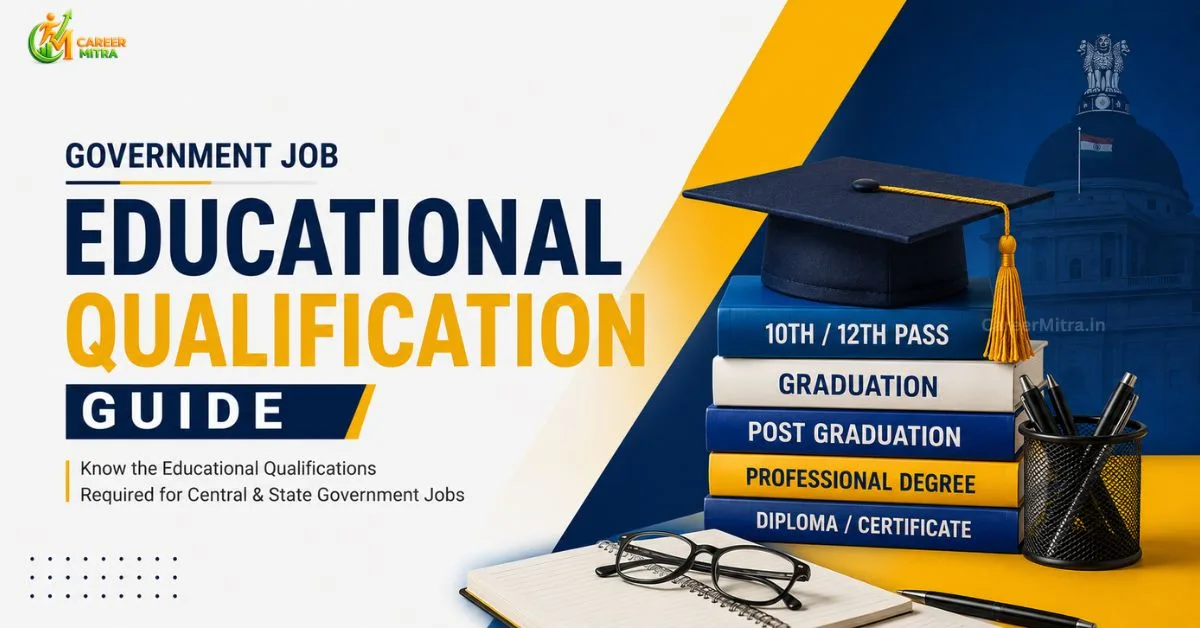

Job security, competitive salaries, allowances, career growth and other benefits are some of the reasons why government jobs continue to be one of the most preferred career options in India. The educational qualification prescribed is one of the most important eligibility criteria for any government recruitment. If you have completed 10th, 12th, ITI, Diploma, Graduation or Post Graduation then there are many government jobs in Central and State Government departments.
In this Government Job Educational Qualification Guide 2026, we have explained the educational eligibility for different qualification levels and major recruiters such as SSC, UPSC, Railways, Banking, Defence, Police, Teaching, PSUs, and many more. This guide will help you to know the government jobs for which you are eligible to apply.
Why Educational Qualification Matters in Government Jobs
Educational qualification is one of the most important eligibility criteria for all government jobs. The required qualification varies depending on the post. Some jobs require Class 10 or 12, and a few others require technical jobs, ITI, Diploma or an Engineering degree. For professional jobs such as teachers, doctors, nurses and lawyers, recognised professional qualifications are required.
Recruiting authorities verify the educational qualification during the document verification process. However, candidates who do not possess the required educational qualification as mentioned in the official notification will not be eligible, irrespective of their performance in the examination. So, always verify the prescribed educational qualification before applying.
Types of Educational Qualifications Accepted in Government Recruitment
In India, Government recruitment is open to candidates from all educational backgrounds. The minimum qualifications depend on the department, post, and recruitment rules applicable to that organisation.
Educational qualifications generally accepted are:
10th Class (Matric/SSC Pass)
Group 12 (Intermediate /Higher Secondary)
ITI Certificate
University degree
Bachelor's Degree
Graduate Degree
Professional Degree like B.Tech, MBBS, B.Ed, LLB, B.Com, B.Sc Nursing, Agriculture, Pharmacy, CA etc.
Some departments also accept equivalent qualifications recognised by the Government of India or the respective State Government. Besides the educational qualification, some posts may require registration with a professional body, skill tests, typing certificates, computer proficiency, physical standards or experience.
Selecting the ideal recruitment according to your qualification increases your chances of selection as well as helps you to avoid unnecessary rejection of applications.
Government Jobs After 10th Pass
There are many government jobs for class 10 passed candidates in Railways, Defence, India Post, PSUs, Central Government, and State Government departments. The jobs are mainly support, technical, skilled and field positions and offer stable careers with promotion opportunities.
For most of the 10th pass government jobs, class 10 (Matriculation/SSC) certificate from a recognised board is required. In some technical posts, ITI certificate in the concerned trade is also required.
Some of the popular government jobs after 10th include:
Multi Tasking Staff (MTS)
Havildar
Railway Group D posts
Postal Department posts
Skilled Tradesman
Apprentice Recruitment
Forest Guard (in many states)
Home Guard (state-specific)
Constable posts (where 10th is prescribed)
Various support staff positions in government departments
Besides the recruitment by the Central Government, nearly all State Governments release vacancies for candidates who have passed Class 10 in departments like Revenue, Forest, Police, Municipal Administration, Public Works, Electricity Boards, Transport, and Rural Development.
Candidates are advised that passing Class 10 alone does not make them eligible for all recruitments. Depending on the nature of the post some organisations may prescribe minimum marks, ITI qualification, physical standards, trade certificates or age specific conditions.
Government Jobs After 12th Pass
The students of Class 10 have a lesser number of 12th pass government jobs in comparison to the students who have completed their Intermediate or Higher Secondary. Class 12 is the minimum educational qualification for many clerical, defence, police, railway, postal and administrative posts.
Most recruitment organisations accept candidates who have cleared class 12 from a recognised board. Some posts may be specific to streams like Science, Commerce or Mathematics, while many recruitments are open to candidates from any stream.
Some of the popular government jobs after 12th include:
Lower Division Clerk (LDC)
Data Entry Operator (DEO)
Postal Assistant
Sorting Assistant
Junior Secretariat Assistant
SSC CHSL posts
Railway NTPC (12th Level) posts
Defence recruitment through 10+2 entries
Police Constable (where 12th is prescribed)
Forest Guard (state-specific)
Village Administrative and revenue support posts in various states
Class 12 passed candidates can also appear in many competitive examinations conducted by SSC, Railways, Defence organisations, State Public Service Commissions, Police Recruitment Boards and other government agencies. Besides, many departments have provision for departmental promotion. Candidates can also be promoted to higher posts after joining the service.
Class 12 opens the door to many government jobs after intermediate. But candidates who subsequently get a graduation degree become eligible for a wider range of administrative, executive, officer-level and specialist posts in the Central and State Governments.
Government Jobs After ITI
Candidates who have completed an Industrial Training Institute (ITI) course are eligible for many technical and skilled government jobs. The ITI qualification provides hands on training in trades such as Electrician, Fitter, Welder, Mechanic, Turner, Machinist, COPA, Electronics Mechanic, Plumber etc. These skills are highly valued government departments that require technical manpower for maintenance, manufacturing, operations, and infrastructure projects.
The eligibility for government jobs through ITI is generally to clear class 10 and obtain an ITI certificate in a relevant trade from a recognised institute. Some recruitment also requires candidates to have a National Trade Certificate (NTC) or National Apprenticeship Certificate (NAC) under the prescribed training framework.
The organisations that recruit ITI qualified candidates are Railways, Defence establishments, Public Sector Undertakings (PSUs), power corporations, heavy engineering companies, ordnance factories and state government departments. Another popular path is apprenticeships offering candidates valuable hands-on experience which can enhance future job opportunities.
Some popular ITI Government Jobs include:
Technician
Junior Technician
Tradesman
Artisan
Electrician
Fitter
Welder
Mechanic
Apprentice
Technical Assistant
Plant Operator
Workshop Staff
Government Jobs After Diploma
Among the technical qualifications, a Diploma is one of the most desirable qualifications for government recruitment. Many technical and supervisory posts are open to diploma holders in Engineering, Pharmacy, Agriculture, Architecture, Computer Science, Civil Engineering, Mechanical Engineering, Electrical Engineering, Electronics or other recognised disciplines.
Eligibility for a diploma is based on the department and discipline required for the post. Most of the technical recruitments require a full-time diploma from a recognised institution approved by the concerned regulatory authority. Some departments may also consider lateral entry diploma holders who meet the eligibility conditions.
Some of the major employers of diploma holders are Railways, State Electricity Boards, Water Resources Departments, Public Works Departments, Metro Rail Corporations, Defence organisations, PSUs, Municipal Corporations and State Public Service Commissions.
Common government jobs after diploma include:
Junior Engineer (JE)
Technical Assistant
Overseer
Section Supervisor
Sub Engineer
Engineering Assistant
Draftsman
Lab Technician
Inspector
Technical Officer (Junior Level)
Most of the government organisations conduct separate recruitment examinations for diploma holders and some others recruit through competitive examination followed by verification of documents and skill tests wherever applicable.
Candidates with diplomas can also pursue higher studies by getting admission directly to the second year of engineering degree programmes. This will make them eligible for higher-level officer posts in government jobs in future.
Government Jobs After Graduation
Graduation is one of the most versatile educational qualifications for government jobs. A bachelor's degree allows for entry into the Central and State Governments into administrative, executive, clerical, investigative, financial, technical and management posts. The graduation is the minimum qualification required for the majority of the competitive exams in India.
One of the biggest advantages of being a graduate is that there are many graduate government jobs available to candidates from nearly all academic disciplines such as Arts, Science, Commerce, Engineering, Agriculture, Pharmacy, Computer Applications and Management. Recruitments are often made on the basis of a bachelor’s degree from a recognised university, regardless of the field of study. These are popularly known as any degree government jobs.
Some of the most popular Government Jobs After Graduation include:
Civil Services
Assistant Section Officer
Income Tax Inspector
Excise Inspector
Auditor
Accountant
Assistant Enforcement Officer
Sub Inspector
Probationary Officer
Specialist Officer (where applicable)
Assistant Manager
Administrative Officer
Executive Officer
State Civil Services Officer
One of the major benefits of being a graduate is that there are numerous graduate government jobs available for candidates from almost all streams of education, like Arts, Science, Commerce, Engineering, Agriculture, Pharmacy, Computer Applications and Management. Recruitments are usually made based on a bachelor's degree from a recognised university, regardless of the field of study. Most recruitments are open to graduates of any discipline, but technical and professional vacancies often require qualifications in specific areas such as Engineering, Law, Agriculture, Nursing, Pharmacy or Commerce.
Government Jobs After Post Graduation
A master’s degree opens up a wide range of specialist, academic, research, administrative and senior government positions. A postgraduate qualification not only improves subject expertise but also opens up opportunities in universities, research institutions, public sector organisations, ministries, regulatory bodies and State Government departments.
Candidates with postgraduate degree like M.A., M.Sc., M.Com., MBA, MCA, M.Tech., M.E., MSW, MPH, M.Ed., and many other recognised postgraduate degrees can apply for these government jobs.
Popular opportunities include:
Assistant Professor
Lecturer
Research Officer
Scientific Officer
Statistical Officer
Project Officer
Administrative Officer
Planning Officer
Senior Technical Officer
Subject Matter Specialist
Economist
Analyst
While some recruitments demand a postgraduate degree in the particular subject, some accept any master’s degree from a recognised university. Additional qualifications like NET, SET, GATE, Ph.D. or relevant work experience may be required for some research and teaching positions.
Candidates should always check the required specialisation, as a postgraduate degree in an unrelated subject does not usually meet the educational qualification required for specialised posts.
Professional Degree-Based Government Jobs
There are some government recruitments for candidates with professional degrees other than general educational qualifications. These positions require specialised academic expertise and are available in fields including engineering, health care, education, law, financial services, agriculture and government administration.
The Central Government Ministries, State Government departments, Public Sector Undertakings, autonomous organisations, regulatory authorities, universities, hospitals, research institutions and defence organisations recruit professional degree holders. Some of the major professional qualifications accepted in government recruitment include:
B.Tech / B.E.
MBBS
BDS
BAMS
BHMS
BUMS
LLB
B.Com.
CA
CMA
CS
B.Ed.
B.Sc. Nursing
GNM
B.Pharm.
D.Pharm.
B.Sc. Agriculture
Veterinary Science
Architecture
Computer Applications
The eligibility criteria for these posts generally include a recognized degree in the relevant discipline. In many cases, candidates must also possess registration with the appropriate professional council, licensing authority, or regulatory body before appointment.
Professional posts, unlike general recruitment, often require candidates to have studied a specific subject at graduation or post-graduation level. Hence, aspirants should check all the educational qualification, specialisation, internship requirements, registration certificates, and other eligibility conditions as mentioned in the official notification before applying.
Qualification-wise Government Job Comparison
Each education qualification can earn you a different category of government jobs. Class 10 and Class 12 qualified candidates can apply for entry level posts while higher qualifications like Graduation, Engineering, Post Graduation and professional degrees will unlock the doors for officer level and specialist posts.
Qualification | Common Government Job Level | Examples |
|---|---|---|
10th Pass | Entry-level support and field jobs | MTS, Railway Group D, Tradesman, Forest Guard, Constable (where applicable) |
12th Pass | Clerical, defence, police and technical support | LDC, DEO, SSC CHSL, Railway NTPC (12th Level), Postal Assistant |
ITI | Skilled technical jobs | Technician, Electrician, Fitter, Apprentice, Tradesman |
Diploma | Junior technical and supervisory posts | Junior Engineer, Technical Assistant, Sub Engineer |
Graduation | Administrative and executive posts | SSC CGL, Banking, UPSC, State PSC, Railways |
Post Graduation | Specialist, teaching and research posts | Lecturer, Research Officer, Scientific Officer, Assistant Professor |
Professional Degree | Discipline-specific officer posts | Engineer, Doctor, Nurse, Law Officer, Agriculture Officer |
Qualification-wise Top Government Exams
Different recruitment agencies conduct examinations for candidates with different educational backgrounds. Understanding qualification-wise government exams helps candidates focus on the opportunities that match their academic qualifications.
Educational Qualification | Top Government Exams | Major Recruiting Organizations |
|---|---|---|
After 10th Pass | RRB Group D, SSC MTS, India Post GDS, Defence Group C, State Class IV Recruitment | Railways, SSC, India Post, Defence, State Governments |
After 12th Pass | SSC CHSL, RRB NTPC (12th Level), SSC Stenographer, Agniveer, Police Constable, State Clerical Exams | SSC, Railways, Defence, Police Departments, State PSCs |
After ITI | RRB ALP, RRB Technician, Apprentice Recruitment, Defence Technical Trades, PSU Trade Apprentice | Railways, DRDO, HAL, BHEL, ONGC, NTPC, ISRO, State PSUs |
After Diploma | JE Recruitment, SSC JE, RRB JE, State AE/JE Exams, PSU Diploma Engineer Recruitment | SSC, Railways, State PSCs, CPWD, PSUs |
After Graduate | UPSC Civil Services, SSC CGL, IBPS PO, SBI PO, RBI Grade B, State PSC, CBI, EPFO | UPSC, SSC, IBPS, SBI, RBI, EPFO, State PSCs |
After Postgraduate | UGC NET, Assistant Professor, UPSC IES/ISS, RBI Specialist, Research Officer, Lecturer Recruitment | NTA, UPSC, RBI, Universities, State PSCs |
After Professional Degree | Engineering Services (ESE), Medical Officer, Nursing Officer, CLAT-based Law Recruitment, Teacher Recruitment (TET/CTET) | UPSC, AIIMS, ESIC, State Health Departments, High Courts, NVS, KVS, DSSSB, State Education Departments |
Qualification-wise Central Government Jobs
The Central Government hires candidates from Class 10th to Post Graduation through different organisations like SSC, UPSC, Railways, Banking institutions, Defence organisations, PSUs, Postal Department, Income Tax Department, Customs, Central Armed Police Forces and many ministries. Usually, those who have completed Class 10 and have ITI qualifications are selected for technical and support positions. Graduates can apply for the posts of officers and administration. Candidates with professional qualifications (like Engineering, Medicine, Law, Agriculture, Commerce, Nursing, Education, etc) can apply for specialised posts of Central Government departments.
Qualification-wise State Government Jobs
State Governments also conduct regular recruitment for candidates with different educational qualifications through State Public Service Commissions, Staff Selection Boards, Police Recruitment Boards, Electricity Boards, Municipal Corporations, Transport Departments, Forest Departments, Revenue Departments, Education Departments, Health Departments, and various government agencies.
The minimum qualification varies according to the post. Some vacancies require only Class 10 or Class 12, while others require Diploma, Graduation, Post Graduation, or professional degrees. Since eligibility conditions differ from one state to another, candidates should always refer to the respective recruitment notification.
SSC Educational Qualification
The SSC qualification depends on the examination and the post being advertised.
SSC conducts recruitment for candidates with various educational backgrounds. Multi-Tasking Staff (MTS) is for Class 10 candidates but Combined Higher Secondary Level (CHSL) requires Class 12 qualification. For most of the graduate level exams like Combined Graduate Level (CGL) a bachelor’s degree from a recognised university is required. Certain posts under SSC may prescribe additional educational qualifications such as Statistics, Mathematics, Economics, Commerce, Finance, or specific professional degrees depending on the nature of the post. Candidates should therefore verify the post-wise educational qualification before applying.
UPSC Educational Qualification
UPSC qualification for most Civil Services examinations is a bachelor's degree from a recognised university or an equivalent qualification.
Any stream candidates like Arts, Science, Commerce, Engineering, Agriculture, Medical, Law, etc can apply if they possess a recognised graduation degree. Some UPSC examinations conducted for technical services prescribe specific educational qualifications related to Engineering, Medicine, Statistics, Economics, or other specialised fields.
The required educational qualification must generally be completed before the prescribed cut-off date mentioned in the official notification.
Railway Educational Qualification
Railway qualification varies greatly depending on the category of posts.
For railway recruitment, eligible candidates include those with Class 10, ITI, Class 12, Diploma, Graduation, Engineering degrees and other technical qualifications. Entry level posts generally require Class 10 or ITI, Non-Technical Popular Categories (NTPC), technical posts, Junior Engineer positions and officer level recruitments require progressively higher educational qualifications.
For some technical recruitment, specific engineering disciplines or ITI trades are also mentioned, so it is important to check the prescribed qualification carefully.
Banking Educational Qualification
The qualification for bank jobs varies according to the post.
Generally, clerical recruitment requires a bachelor’s degree from a recognised university. Graduation is also required for Probationary Officer (PO), Specialist Officer (SO) and managerial level posts. Depending on the post, Specialist Officer recruitment may also require Engineering, Law, Agriculture, MBA, CA or other professional qualifications.
The candidates should also have the requisite knowledge in computers wherever it is prescribed in the recruitment notification.
Defence Educational Qualification
The defence qualification depends upon the entry scheme and service branch.
Defence organisations recruit candidates from 10th to Engineering and professional degrees. Recruitment at the Soldier level may require Class 10 or Class 12. Officer entries generally require graduation or Engineering degrees. Technical branches require certain educational background in Science, Mathematics or Engineering.
In some entries, it is also mentioned that the candidates should have studied Physics and Mathematics at the Class 12 level.
Police Educational Qualification
The police qualification varies according to the rank and the recruiting state or organization.
As per the recruitment rules, Constable recruitment may require Class 10 or 12. The recruitment of sub-inspectors generally requires graduation from a recognised university. Police specialists in the Cyber Crime, Forensic Science, Legal, Medical, and Technical Wings are often required to have professional qualifications relevant to the position.
Candidates should always check the educational qualification prescribed by recruiting authority as it varies from state to state.
Teaching Educational Qualification
The qualifications of the teacher depend upon the level of teaching and the recruiting organisation.
Different educational qualifications are required for teaching posts at primary, upper primary, secondary and higher secondary levels. A relevant bachelor’s or master’s degree and a B.Ed. qualification wherever applicable, are required for most teaching recruitment. Candidates for some teaching posts are also required to have qualified Teacher Eligibility Tests (TET), CTET or State TET examinations.
Higher education institutions and universities normally ask for post-graduate qualifications and may also lay down other requirements like NET, SET or Ph.D. for posts.
PSU Educational Qualification
The PSU qualification varies according to the organization and the post.
The Public Sector Undertakings recruit candidates with ITI, Diploma, Graduation, Engineering degrees, CA, CMA, MBA, Law, Agriculture, Medical, Nursing and many other professional qualifications. Technical officer recruitment generally requires engineering degrees, and discipline-specific qualifications are required for finance, legal, HR and management positions. Several PSUs also recruit through national-level examinations such as GATE or conduct their own recruitment processes depending on organisational requirements.
Open University & Distance Education Eligibility
Candidates who have completed their education through recognised Open Universities or Distance Education programmes are generally eligible for government jobs, provided the qualification is recognised by the appropriate regulatory authorities and the recruitment notification does not specifically prohibit such qualifications.
For recruitment purposes, government departments usually give equal status to recognised distance education degrees as regular degrees. However, candidates should verify that their university and programme were approved by the competent authority during the period they pursued the course. For technical, medical, teacher education, and professional courses, additional regulatory approvals may also be required wherever applicable.
Final Year Students Eligibility
Many candidates ask if final-year students can apply for government jobs.
The answer is that it depends on the recruitment notification. Some examinations allow candidates in the final year of their qualifying examination to apply provisionally, provided they can provide proof of passing before the prescribed cut-off date.
However, many recruitment processes demand that the candidate should possess the required educational qualification on or before the last date of application or any other date as specified in the notification. Candidates who shall not have obtained their degree before the prescribed date shall not be eligible.
So, the final year students need to go through the eligibility clause properly before applying.
Minimum Percentage Requirements
A common myth among candidates is that all government jobs require a minimum percentage of marks. In actual practice most of the government recruitment examinations do not prescribe any minimum percentage in the qualifying examination. Candidates shall normally possess the required educational qualification from a recognised institution.
But some recruitments, especially for PSUs, technical organisations, research institutes, universities and specialised professional posts, may have minimum marks, CGPA or class/division requirements. For example, some organisations demand that candidates should have secured a stipulated percentage in Engineering, Management or other professional degree programmes.
Candidates must not assume that possessing a qualification automatically makes them eligible. Before applying, they should always check the recruitment notification for any mention of minimum percentage, CGPA conversion rules or academic performance criteria.
Additional Certifications Required for Certain Posts
The primary eligibility criterion is the educational qualification but many government recruitments also require the candidates to have some additional certifications or licenses or professional registrations. These certifications are to ensure that the candidates have the practical skills or the legal authorisation to meet the duties of the post. For example, teaching posts often require candidates to qualify in CTET or the respective State TET in addition to holding the prescribed educational qualification. For Nursing posts, registration with the respective State Nursing Council or the Indian Nursing Council is mandatory. For Medical posts, registration with the National Medical Commission (NMC) or the appropriate medical council is required. Law Officer positions may require enrollment with the Bar Council, and Chartered Accountant posts require membership of the Institute of Chartered Accountants of India (ICAI).
Some recruitments may also prescribe:
Typing proficiency or stenography certificate
Computer proficiency certificate
Driving licence for driver and transport-related posts
Trade Certificate or National Apprenticeship Certificate (NAC)
Professional registration or licence
Language proficiency certificate (where applicable)
Documents Required for Qualification Verification
Candidates who clear the written examination will have to undergo document verification to ensure that they fulfil all the eligibility conditions. In this stage, the recruiting authority verifies educational qualifications, identity, category, age and other documents. The commonly required documents include:
Class 10 certificate (proof of date of birth)
Class 12 certificate and marks memo
ITI, Diploma, Graduation or Post Graduation certificates
Semester-wise or year-wise mark sheets
Provisional degree certificate (where accepted)
Degree or Convocation certificate
Professional registration certificate (if applicable)
Equivalency certificate (where required)
Caste or category certificate (if applicable)
PwBD certificate (if applicable)
Government-issued identity proof
Passport-size photographs
All documents should be original, complete, consistent and candidates must ensure the same. Any mismatch in Name, Date of Birth, Educational Qualification or marks may cause delay or rejection in verification.
Common Qualification-Related Rejection Reasons
Every year a large number of applications are rejected due to the candidates not fulfilling the required educational qualification or giving wrong information while applying. If the recruitment notification is read carefully before applying, then these mistakes can be easily avoided. Some of the most common reasons for rejection include:
Applying without possessing the required qualification.
Obtaining the qualification after the prescribed cut-off date.
Degree or diploma not recognized by the competent authority.
Incorrect educational details entered in the application form.
Applying with a different discipline or specialization than the one prescribed.
Failure to produce original certificates during document verification.
Submitting incomplete mark sheets or provisional certificates where a final degree is mandatory.
Mismatch between certificates and application details.
Failure to submit required professional registration certificates.
Candidates should always verify every educational detail before final submission, as corrections are often not permitted after the application window closes.
How to Choose the Right Government Exam Based on Qualification
It is as important to choose the right government exam as it is to fulfil the eligibility criteria. Candidates should apply for only those recruitments which are relevant to their educational qualification, interests and long-term career goals, instead of applying for all the recruitments available.
After Class 10, candidates can begin with entry-level recruitments in Railways, SSC, Defence, Postal Department and many State Government departments. Those with Class 12 qualification can target clerical, defence, police and railway examinations. Those with ITI and Diploma should target technical recruitments by Railways, PSUs, Electricity Boards and engineering departments.
Graduates get the maximum number of opportunities like SSC CGL, UPSC, Banking, Insurance, Railways, State Public Service Commissions and many departments of Central Government. Candidates with postgraduate or professional degrees may apply for specialist recruitments in education, healthcare, research, engineering, finance, law, agriculture and public sector organisations.
Before applying for any recruitment, candidates should ask themselves the following questions:
Does my educational qualification match the eligibility criteria?
Is my degree recognized by the required authority?
Do I possess any additional certifications required for the post?
Have I completed my qualification before the prescribed cut-off date?
Am I eligible based on age, nationality, and other recruitment conditions?
Conclusion
Educational qualification is the basic eligibility of each and every government jobs. Government jobs after 10th, government jobs after 12th, government jobs after ITI, government jobs after diploma, government jobs after graduation, government jobs after post-graduation, whatever may be the case, it is important to know the prescribed qualification before applying.
Every recruitment notification has clearly mentioned the required educational qualification, recognised institutions, cut-off date and any other certification required for the post. Candidates must not assume or rely upon information from unofficial sources. They should go through the official notification carefully and ensure that they meet all the eligibility criteria before applying instead.
Candidates can increase their chances of success and have a successful career in the government sector by selecting the right qualification-wise government exams and only apply for posts that match their academic background.
Frequently Asked Questions (FAQs)
What is the minimum educational qualification for government jobs?
The minimum educational qualification for any government job depends on the post and the minimum eligibility mentioned in the notification. Some government jobs require Class 10, while others require Class 12, ITI, Diploma, Graduation, Post Graduation, or professional degrees.
Can I apply for government jobs after 10th pass?
Yes. There are several government jobs a candidate with Class 10 pass educational qualification is eligible for, such as MTS, Railway Group D, Tradesman, Forest Guard, and several State Government recruitments, subject to the eligibility conditions prescribed in the notification.
Which government jobs are available after 12th pass?
Class 12 candidates can apply for SSC CHSL, Railway NTPC (12th Level), Postal Assistant, Defence recruitment, Police Constable, clerical posts, and many State Government vacancies.
Can diploma holders apply for government jobs?
Yes. Diploma holders are eligible for technical posts such as Junior Engineer, Technical Assistant, Sub Engineer, and other engineering-related positions in Central and State Government departments.
What documents are required to verify educational qualification?
Candidates are generally required to produce educational certificates, mark sheets, degree certificates, provisional certificates (where accepted), professional registration certificates (if applicable), identity proof, and other documents specified in the recruitment notification.