
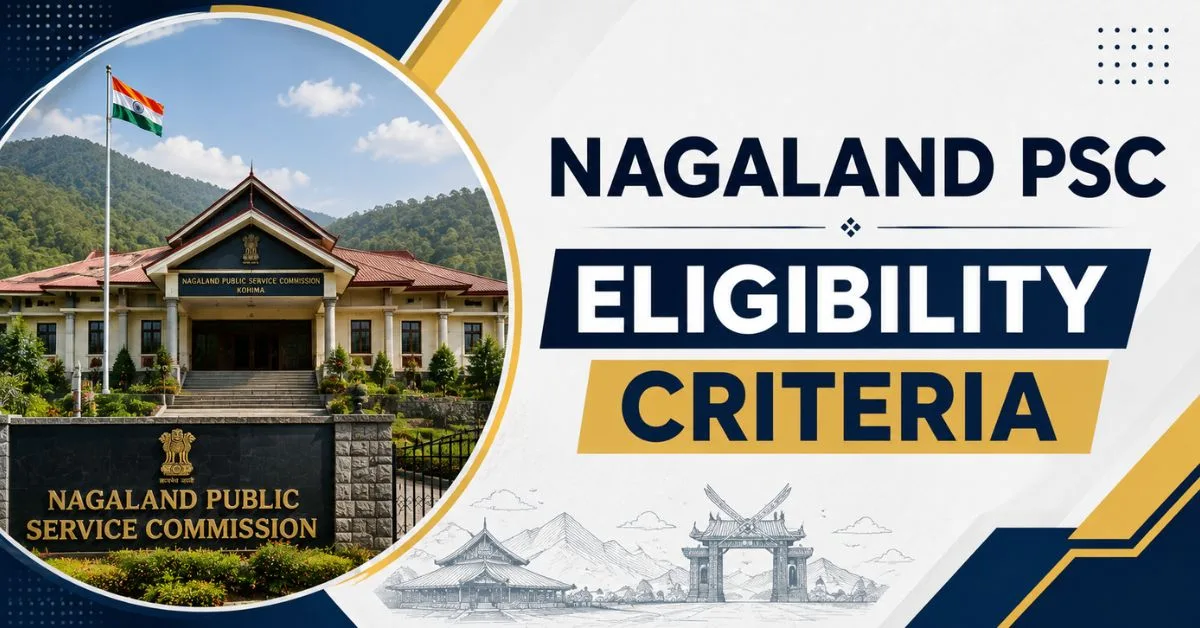

The Nagaland Public Service Commission has been running recruitment since 1965, which makes it older than several of the state bodies around it. It doesn't work the way most people expect a state PSC to work. There's no single exam that covers everything. NCS, NPS & Allied Services handles administrative and police posts. The Combined Technical Services Examination (CTSE) is a separate track built for engineers, doctors, and other technical staff. The Common Educational Services Examination (CESE) runs on its own calendar for teaching posts. Three exams, three age bands, three qualification rules, three fee structures and Career Mitra has seen candidates prepare for the wrong one entirely, or miss a deadline for an exam they were actually eligible for, because they assumed NPSC worked like a single combined service.
Who Can Apply: Nationality and Basic Requirements
Indian citizenship is mandatory for any NPSC post and is checked through valid ID at the time of verification. What is unique to Nagaland is how the demographics of the state shape the structure of reservation. The Scheduled Tribes form the vast majority of Nagaland’s population, and NPSC reserves seats for recognised Naga tribes and other indigenous communities of the state, not for ST candidates from anywhere in India. An ST candidate from another state doesn’t carry that reservation status into Nagaland’s recruitment.
The application process starts with the NPSC’s One Time Registration (OTR) system on the official portal that creates a base candidate profile. From there, a candidate applies separately for NCS/NPS, CTSE or CESE as per the stream. These run as distinct application processes, not one combined form.
NPSC Recruitment: Different Faces
Exam | What It Recruits For | Age Band | Degree Needed |
NCS, NPS & Allied Services | Administrative / Police: EAC, DSP, BDO, Excise Inspector, etc. | 21-30, relaxation for SC/ST and government servants | Graduation, any stream, including Divinity |
CTSE (Combined Technical Services) | Engineering / Medical / Veterinary / Law / Statistics / Pharmacy / Food Safety | 21-32, as on January 1 | Qualification, relevant to the particular technical subject |
CESE (Common Educational Services) | Assistant Professor, Lecturer, PGT, GT, Librarian, Research Associate | 21-32, as on January 1 | Post-graduation, relevant subject, NET/SET/B.Ed. as required |
NCS has a tighter age band than the other two, 21-30, compared to their 21-32. The three-year gap takes candidates by surprise, particularly those who believe that the wider band is applicable everywhere, since it is more frequently seen in recent notices.
Education Qualification: The Specific Requirement of Each Stream
NCS has a simple requirement: a bachelor’s degree from a recognised university, in any discipline, makes you eligible. That includes Divinity degrees specifically, a detail NPSC points out in its own eligibility notes most other state PSC exams don’t bother spelling out. Students in the final year, awaiting results, can also apply, so there is no need to wait for convocation to appear for Prelims.
CTSE works differently. It comprises 49 different post-specializations starting from Civil, Electrical engineering, medicine, veterinary science, statistics, law, Pharmacy and food security and every post code has its own degree requirement. No general rule here to fall back on checking the post code, not a summary. CESE uses similar logic post by post for teaching posts. UGC norms in force normally require a postgraduate degree in the subject taught, often augmented by NET, SET or a doctoral qualification for Assistant Professor and Lecturer posts. PGT and GT posts require a matching subject degree, along with a B.Ed.
DSP is an important position within the NCS cadre, and similar to most DSP recruitments from Indian State Services, this comes with certain physical standards which a mere degree cannot meet. According to the latest criteria laid out by NPSC for the position of DSP, the minimum height required for males was 5 feet 4 inches (5 feet 2 inches for SC/ST) with a chest expansion of 33 inches (32 inches for SC/ST) to 35 inches (33.5 inches for SC/ST). Positions of Assistant Jailors had a different set of minimum heights applicable to them. The above numbers are according to NPSC’s latest notification on DSP, which has been issued without any change since. Physical standards are one such criterion whose values may keep changing from one notification to another. So use them as an indicative value rather than anything permanent.
Age Limit and Relaxation According to Category
The age limit for NCS is 21 to 30 years.
Category | NCS Max Age |
General/Unreserved | 30 years |
SC/ST | 35 years |
Government Employees (in service) | Equivalent number of years' relaxation not exceeding five years |
Persons with Disabilities | According to the relevant rules |
CTSE and CESE both operate on the broader 21 to 32 bands, with the same 5 years of relaxation for SC/ST students and for employees in the service of the Government. The age is counted from the mark sheet of SSC or its equivalent, or the birth certificate in case this is not available – NPSC will not accept any other document as proof, and hence, one mistake on this particular paper is enough to disqualify the candidate before the examination itself.
Rules on Domicile and Reservation Categories
Nagaland does not operate on a basic domicile certificate system. There are several certificates required by NPSC based on what the candidate claims and getting them confused is one of the most common reasons why a well-qualified candidate is denied eligibility in verification. The certificate of a particular Scheduled Tribe (ST) based on the tribe identified in Nagaland is the requirement of an applicant making a claim for ST reservation. This should be a duly authorized State authority and the certificate is not issued by a generic "ST" but a particular recognized Naga tribe. Those applicants who are not ST but are native residents of the state claim eligibility through a different certificate. They are known as the Indigenous Inhabitant (I.I.) Certificate holders. NPSC notices usually reserve seats for I.I. candidates separate from those of STs and Backward Tribes (B.T.). The Permanent Resident Certificate (PRC), also known as a Domicile Certificate, is mostly meant for people who stayed in Dimapur and its surrounding areas before December 1, 1963, and don't come within the purview of the Tribal/Certificate scheme at all. This certificate confirms the domicile status rather than that of being tribals or indigenous people. It is issued by the Deputy Commissioner of the respective district.
Non-Naga aspirants can still apply for positions in the general/unreserved quota for all the three tests. However, they cannot avail of the ST, I.I. or B.T. quota with a domicile certificate issued by another state for some other purpose, even if they are Scheduled Tribes from their own states. Nagaland follows the Inner Line Permit (ILP) regime, whereby non-residents have to acquire an ILP before entry into the state. Nagaland made ILP mandatory for Dimapur, Chümoukedima and Niuland districts in September 2024, which had been excluded earlier. This does not make any difference to the eligibility to apply for NPSC positions, but it should be kept in mind by outstation aspirants coming to Nagaland for Mains or interviews.
Career Mitra Pro-Tip: Refer to your certificate for your particular tribe to ascertain which certificate you qualify for as per the current year's notification. This is because the certificate issued by Nagaland does not work in a similar manner as that of the national ST category, and it is better to know this upfront to save yourself from a denial later.
Selection Process: Differences Between the Streams
NCS, NPS & Allied Services runs through three stages, the closest thing NPSC has to a UPSC-style structure. Prelims is a single objective paper worth 200 marks, working purely as a screening round, nothing from it carries forward into the final rank. Candidates get shortlisted for Mains at roughly 1:10 per post, based on Prelims marks alone.
Mains is written and descriptive, carrying 600 marks split across three papers:
Paper | Subject | Marks | Format |
Paper I | General Essay, Comprehension and Grammar | 200 | Descriptive: 2 essays along with comprehension and grammar portions |
Paper II | General Studies I | 200 | Objective: Modern History of India and Indian Culture, Nagaland's geography, society, culture and heritage, and Nagaland administration |
Paper III | General Studies II | 200 | Descriptive: questions for 2 to 20 marks - Indian polity and governance, Indian economy and geography, societal and global problems such as child labour, gender discrimination, minorities, illiteracy and poverty |
Those candidates who qualify for Mains will be subjected to a Personality Test that carries a weightage of 75 marks, wherein the panel evaluates the candidate’s familiarity with the local etiquette, traditions, and language, along with his/her general awareness. The marks in interview will be directly added to the marks in Mains, and the total score is out of 675, which determines the final ranking. Unlike other State Public Service Commission exams, NPSC does not provide a definite master list of the optional papers; rather, the list of the optional subjects appears in each Mains notification. It is observed that candidates opt for History, Political Science, Geography, or Sociology because the preparation material for these subjects is easily available compared to others. However, candidates must avoid blindly following the trend without considering the subjects mentioned in the notification and their compatibility with them.
CTSE and CESE have much shorter processes as well. CTSE introduced a new format of examination through notification number NPSC/EXAM-1/2025, dated 3 February 2025, having corrigendum on 26 March 2025. This process is generally a written examination of the concerned technical/subjective knowledge followed by an interview and not the Mains type paper based lengthy essay oriented process which was followed before 2025 and for which NCS has been known. Any candidate preparing using the old books/material should get the latest syllabus from the website of NPSC and not depend on the old PDF files. In CESE also there are only two parts of examination – Written Examination (divided into general knowledge and subject-based sections) followed by interview for selected candidates. Both of these two schemes do not require any optional subject as required by the NCS scheme.
Which NPSC Exam Suits You
The NCS gives the widest range of administrative/police services through a single exam in the form of the posts of EAC and DSP. The NCS does not have any academic requirements beyond the general bachelor’s degree but the upper age of 30 years is more stringent than the other two streams.
The CTSE gives the technical stream for engineering/medical/veterinary/law graduates in 49 different post categories and has a more liberal age range than the NCS.
The CESE gives the straight pathway for postgraduate candidates aspiring to government teaching and lecturing posts. It also has the wider age range of 32 years.
Those candidates belonging to a Naga tribe, another indigenous community, or having I.I./PRC category must confirm which particular certificate category they qualify for with reference to the notification of that particular year.
The Career Mitra system also monitors vacancy trends separately for each of the 49 CTSE categories, since there is very little competition in certain technical disciplines compared to the number of seats available.
Documents to be prepared by Candidates before appearing in NPSC Exams
Have all these things prepared irrespective of which stream you are applying for:
Proof of valid identification
Certificate and mark sheets of degree
SSC or equivalent certificate in support of date of birth
Appropriate certificate as proof of claim for reservation (ST/I.I./B.T./PRC, depending on the case) duly signed by the relevant district authority
Photographs as per the prescribed format
For CTSE applicants, the specific degree certificate in the particular field is required in addition to the relevant post code, while for CESE applicants, the postgraduate certificate along with NET/SET/B.Ed certificates is required when the post demands it.
The common reason behind most of the rejection letters can be attributed to some common faults: applying after crossing the age limit applicable for that particular examination, showing reservation by using an incorrect certificate or a certificate issued from outside Nagaland, different date of birth in various certificates, and lastly an incorrect qualification for the particular post code.
Final Thought
What stands out about NPSC is how well it distinguishes between three completely different examinations and not simply groups all under the blanket category of the civil service examination. NCS handles the administrative and police services examination in the usual UPSC three-tier format, plus an age limit and an increased fee compared to the previous cycle which is quoted on many of the blogs and websites still around. CTSE covers almost fifty post categories under technical services, each with its unique criterion, and recently shifted to a new exam pattern making some of the old study material obsolete. CESE conducts the teaching and academic recruitment by itself on a different timeline. And none of these follow the same cycle, making the assumption of a similar time period cause candidates to miss out on their eligibility through no fault of their own. Going through every announcement individually, finding out which certificate qualifies you for a specific exam, and which stream corresponds to your degree is what protects your preparation.
FAQs
What is NPSC?
Nagaland Public Service Commission, which was constituted in 1965, carries out state government recruitment through three major examinations - NCS and NPS & Allied Services (for administrative & police posts), CTSE (for technical and medical posts), and CESE (for teaching & academic posts).
Does NPSC conduct only one examination (NCS)?
No. In addition to NCS, NPSC conducts CTSE for engineering, medical and technical posts and CESE for teaching & lecturer posts in separate notices with different age bars and qualifications.
What is the examination fee for NPSC examination?
The examination fee for both NCS and CTSE is Rs. 300 plus convenience fee of Rs. 25 plus applicable payment gateway charges. This replaces the old Rs. 310 fee quoted in older sources. However, candidates are advised to check CESE notice.
Are there any restrictions on attempts for NPSC examinations?
No. There are no upper limits to attempts for NCS, CTSE and CESE provided the candidate qualifies the age and other criteria for that year's notice.
What is the age criterion for NCS 2026?
Candidates must be aged between 21 and 30 years as on 1st January of the notification year. Age relaxation up to 35 years will apply for SC/ST candidates.
What is the age criterion for CTSE and CESE?
Both examinations are conducted on an extended age limit of 21 to 32 years as on 1st January. A similar age relaxation of 5 years is available for SC/ST candidates and serving government employees.
What is the qualification for NCS?
B.A./B.Sc./B.Com. Degree from any recognized University, Divinity included. Final year students are eligible to apply for NCS if they have passed all other examinations of their degree except final year.
Are there any physical standards for DSP Recruitment in NPSC?
Yes. The latest set of physical standards required for DSP Recruitment in NPSC are a minimum height of 5 feet 4 inches for males (5 feet 2 inches for SC/ST) with chest sizes of 33 inches unexpanded and 35 inches expanded (32 inches and 33.5 inches respectively for SC/ST).
Can applicants from other states appear in NPSC exams?
Yes, in the unreserved/general category. However, reservation based on Scheduled Tribes of Nagaland, Indigenous Inhabitants or Backward Tribes is only valid for applicants who possess the proper certificates issued in Nagaland and not equivalent status from another state.
What is the Selection Procedure for NCS?
Preliminary (200 marks - screening only), Main (600 marks over three papers, namely, General Essay, General Studies I and General Studies II) and an Interview (75 marks). Total Merit - 675 (Mains and Interview).
What is the Selection Procedure for CTSE and CESE?
Both generally follow the format of Written Examination and Interview without the three paper essay type Mains held in NCS. CTSE currently follows the New Pattern of Examination announced in February 2025.
Where can one view NPSC Notifications and register online for NPSC Exams?
The NPSC official website is npsc.nagaland.gov.in. Career Mitra keeps track of the latest notifications released for the various NPSC recruitment streams including NCS, CTSE, CESE etc.